
Equities
AI stocks fall back after Monday’s rally — but market breadth tells a different story
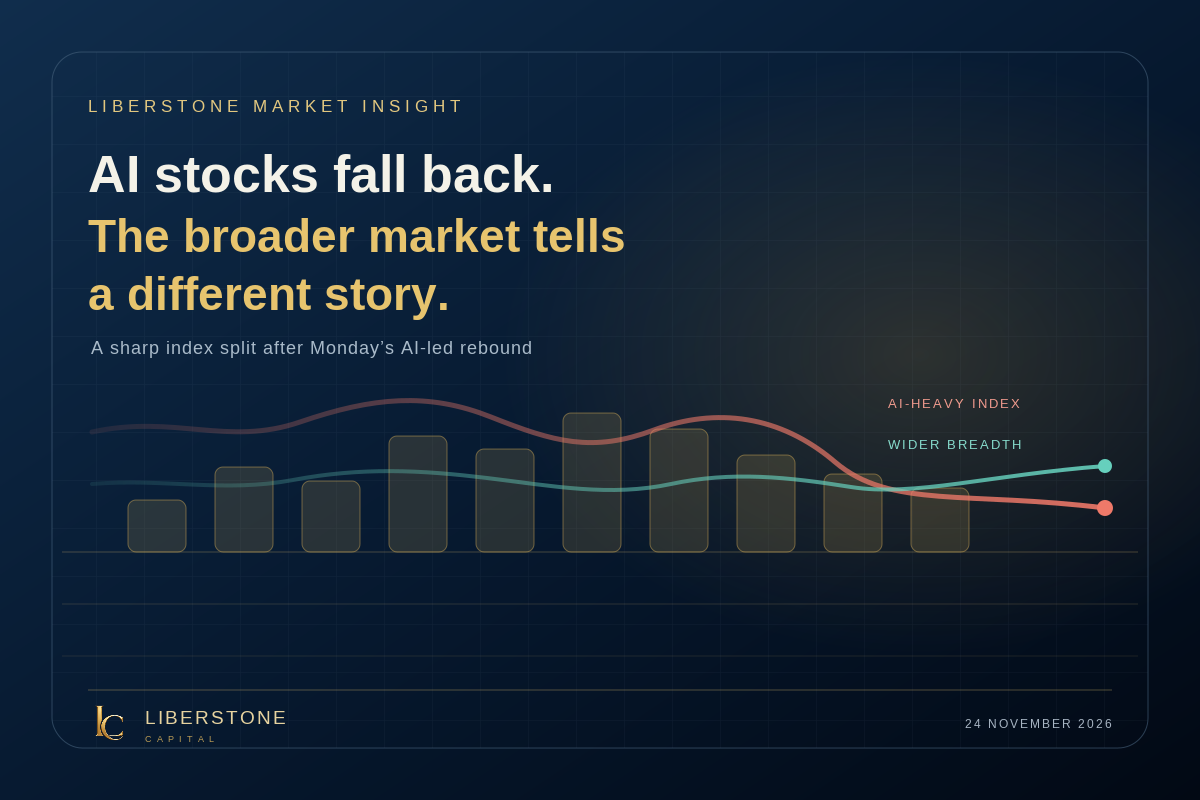
At 10:45 a.m. ET on 24 November, AI-linked losses pulled the Nasdaq down 2.1% and the S&P 500 down 1%, while the Dow was nearly flat and many other shares were higher. The split suggests a concentrated repricing—not yet a broad-market breakdown.
Published 24 November 2026. This analysis uses the 10:45 a.m. Eastern Time market snapshot reported by the Associated Press; it is an intraday reading, not the final close.
A one-day reversal, and a revealing split
On Monday, 23 November, Nvidia rose 31.5% and the Nasdaq gained 6.5% after Nvidia announced Jensen Huang’s return as chief executive. By 10:45 a.m. Tuesday, Nvidia had fallen 7.8%, the Nasdaq was down 2.1%, and the S&P 500 was lower by 1%. The Dow was almost unchanged. AP reported that most stocks outside the AI group were holding up better, with many rising.
That divergence matters. The headline indexes do not represent an equally weighted average of every listed company. A small group of very large AI and semiconductor companies can pull the Nasdaq—and, to a lesser extent, the S&P 500—down even while the typical stock is steady or higher. A weak index reading therefore does not, by itself, prove that selling has spread across the whole market.
The reversal also shows why a leadership announcement is not the same as a change in future cash flows. The return of a prominent executive may ease one company-specific uncertainty, but it does not answer investors’ larger questions about the returns on data-centre spending, how quickly AI products can be monetised, or the cost of financing expansion while borrowing rates remain high. Tuesday’s moves underline that distinction; they do not establish that the AI investment cycle has ended.
What the broader data does—and does not—say
The Conference Board’s November Consumer Confidence Index rose to 103.3 from 91.9 in October. That is a meaningful improvement in reported household confidence, but it is not a measure of AI-company profitability or a guarantee of stronger share prices. It provides a counterweight to a purely recessionary reading of the market, not a resolution of the technology-sector debate.
LiberStone’s assessment
Our base case for the next several sessions is continued index volatility with unusually large influence from AI and semiconductor leaders. The key distinction is whether the retreat stays concentrated in those names or starts to weaken the wider advance. The 10:45 a.m. snapshot supports the first interpretation more than the second: the Nasdaq and S&P were lower while the Dow was nearly flat and many non-AI shares were advancing. That is a dated observation, not a claim about the close or a forecast of what comes next.
This view would become less convincing if declining shares began to outnumber advancers across sectors, equal-weighted U.S. indexes weakened alongside their market-cap-weighted counterparts, and volatility broadened beyond technology. It would also need revisiting if AI leaders stabilised while participation improved across sectors; that would suggest the market was digesting a concentrated correction rather than entering another broad sell-off.
What to monitor
For the next few sessions, compare the Nasdaq and semiconductor stocks with an equal-weighted S&P 500 measure and the daily advance-decline breadth. Watch Treasury yields and Federal Reserve rate expectations because financing costs affect long-duration growth valuations. For the AI thesis itself, the more durable evidence will be company guidance on capital spending, utilisation and revenue conversion—not a single executive headline or one day’s index move.
If broad-market participation deteriorates alongside technology, the risk is shifting from a sector repricing toward a wider risk reduction. If breadth remains resilient and AI companies show measurable monetisation, the latest reversal may prove narrower than the index headlines imply. Neither scenario is settled by this morning’s data.
Sources
Associated Press, 24 November 2026, intraday market report: apnews.com
The Conference Board, November 2026 Consumer Confidence release: www.conference-board.org
Reuters, 24 November 2026, report on the retreat in AI-linked shares after Monday’s rally: www.investing.com